

I'm going to tell you a story that sounds like a lie until you see the numbers.
My renovation finished six months late. Not six weeks. Not two months. Six full months. The windows were late, the cabinets were later, the tile setter disappeared for three weeks, and the GC had to rebook every trade at least twice. By the end, I'd stopped putting dates on my calendar. I just showed up every morning and asked "what's happening today?"
And yet – here's the part that makes people's eyes go wide – my final invoice was exactly what I signed for. No change orders. No upcharges. No "we found rot behind the wall, that'll be an extra $4,000." Not a single dollar over the original contract price.
How? Not because I was lucky. Because I structured the contract and the relationship differently from the start. And I'm going to tell you exactly how – not because I'm proud of the six‑month delay, but because I think the trade‑off I made is worth understanding.
The contract structure

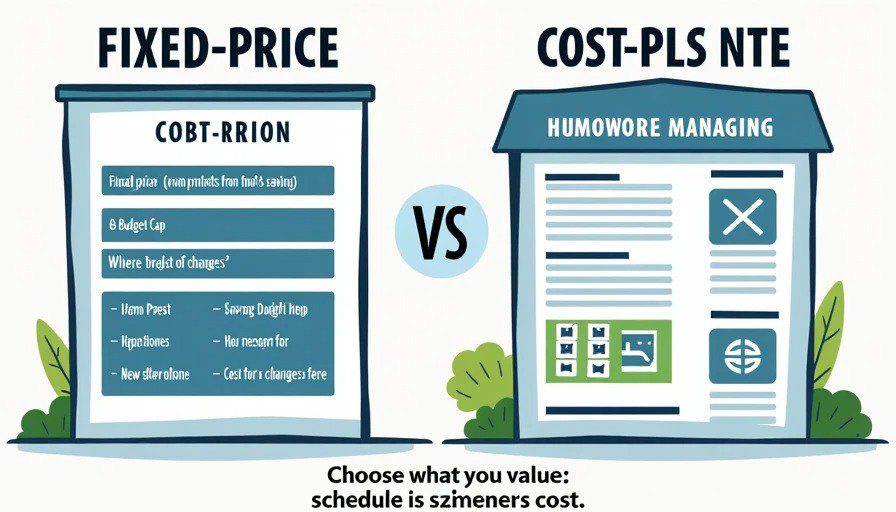
Most renovation contracts are fixed‑price with a long list of exclusions. That's the industry standard. The GC quotes you a price, you sign, and then every time something unexpected happens, you get a change order. The GC says "this wasn't in scope," you sign a piece of paper, and the price goes up.
I did the opposite.
I signed a cost‑plus contract with a not‑to‑exceed (NTE) cap. Here's how it worked:
I agreed to pay the GC's actual costs for labour and materials – no markup on those.
I agreed to pay a fixed management fee of 15% of the budget (not of the final cost – of the budget).
I agreed to a NTE cap: the GC could not exceed $120,000 total without my written approval.
I agreed that any change to the scope (not the schedule) would be handled through a formal change order process.
I agreed that any cost overruns within the scope would be borne by the GC, not by me.
The key was the incentive alignment. With a fixed‑price contract, the GC profits when they spend less and finish faster. With cost‑plus, the GC doesn't profit from cutting corners – they profit from managing well. And with the NTE cap, they have a strong incentive to stay within budget, because every dollar over comes out of their own pocket.
But the real magic was in the scope definition. We defined the scope at a very high level – "gut renovation of kitchen, two bathrooms, all new floors, windows, and doors" – but we explicitly excluded the schedule from the scope. The contract said: "The schedule is a best‑efforts estimate, not a guarantee. Delays caused by material availability, trade availability, or unforeseen conditions are not change‑order events."
That meant: when the windows were late, I didn't pay for idle labour. When the tile setter disappeared, I didn't pay for rebooking fees. When the cabinets took 16 weeks instead of 12, the GC ate the cost of keeping the site open. The schedule was his problem to manage – not a lever to increase my bill.
The relationship structure
But the contract was only half of it. The other half was the relationship.
I chose my GC not because he was the cheapest or the fastest, but because he was the most transparent. I interviewed five GCs. Four of them gave me fixed‑price quotes with glossy brochures and tightly worded exclusions. One of them – the one I hired – said: "I can give you a fixed price, but I'll build in a 30% contingency and you'll pay for every change. Or we can do cost‑plus, I'll be completely open about my costs, and you'll know exactly where every dollar goes."
I asked him: "Why would you do that? Wouldn't you make more money on a fixed‑price contract?"
He said: "Because I'm tired of fighting with homeowners about change orders. When you see my costs, you trust me. And when you trust me, you refer me to your friends. I make my money on referrals, not on fighting."
That was the key insight: he valued his reputation more than the extra margin he could squeeze out of a fixed‑price contract. And I valued cost certainty more than schedule certainty. So we were a perfect match.
The rules we agreed on:
Weekly cost reports. Every Friday, I got a spreadsheet showing every dollar spent that week – labour, materials, permits, and a running total against the budget.
Weekly schedule updates. Every Friday, I got a written update on what was done, what was delayed, and what was expected next week (this was where I used the Google Sheets template I shared in another post).
No surprises. If the GC saw a cost overrun coming, he had to tell me immediately, not at the end. We'd decide together how to handle it.
No blame. If a trade didn't show up, we didn't argue about whose fault it was. We just found the next available date and kept moving.
The result: I had perfect cost visibility. I knew exactly where my money was going. And when the schedule stretched, I was frustrated – but I wasn't paying for it. The GC's management fee was fixed, and his profit margin was capped. He had every incentive to keep the schedule tight, and when he couldn't, he was the one who suffered, not me.
The trade‑off
Here's the honest truth: if you want both schedule discipline and cost discipline, you're going to pay for it. You'll pay in higher upfront prices, larger contingencies, or a GC who only works on tight‑schedule projects and charges accordingly.
I chose cost discipline over schedule discipline. I paid the exact amount I signed for – and I traded six months of my life for that guarantee.
Was it worth it? For me, yes. I had flexible housing. I could stay with family during the renovation. I didn't have a hard move‑in deadline. But if I'd been on a strict timeline – if I had a lease ending, a baby on the way, or a buyer waiting – I'd have chosen differently.
The key is to know what you value more, and structure your contract accordingly.
How you can do this (if you want to)
This approach isn't for everyone. Some GCs won't do cost‑plus contracts because they prefer the predictability of fixed‑price. Some homeowners can't handle the uncertainty of a schedule that might stretch. But if you're considering it, here's the playbook:
Step 1: Find a GC who values transparency over margin.
Look for someone who has been in business for at least 5 years, has a strong referral network, and talks openly about costs. Ask them: "Would you consider a cost‑plus contract with a cap?" If they say "no" immediately, move on. If they say "tell me more," you've found a potential partner.
Step 2: Define the scope clearly (but loosely).
Don't list every outlet and light switch. Define the major work areas, the general quality level, and the major material categories. The more specific you are, the easier it is for the GC to argue that something is "out of scope." Keep it broad enough that most things are in scope.
Step 3: Set a realistic budget – and a cap.
Work with the GC to build a detailed budget estimate. Then add a 15–20% contingency for unforeseeables. The cap should be the total budget (including contingency). If the GC goes over the cap, they eat the cost – but only if the scope hasn't changed.
Step 4: Build a change‑order process that's fair.
If you change the scope – for example, if you decide to add a third bathroom or upgrade to marble counters – that's a scope change, and it should be handled through a change order with a clear price. But if the GC discovers that your joists are rotted and need replacement, that's not a scope change – it's an unforeseen condition, and it should come out of the contingency.
Step 5: Commit to weekly transparency – on both sides.
You get weekly cost reports and schedule updates. You also agree to make decisions within 48 hours when the GC asks for them. You're a team. If you slow down the process, you pay for it – not in money, but in schedule. And if the GC slows it down, they pay in lost time.
The biggest lesson: schedule vs. cost
This is the question that every homeowner has to answer for themselves.
Schedule discipline means you finish on time, or close to it. You book trades in advance, you order materials early, and you pay a premium for the certainty. You pay more to move faster.
Cost discipline means you stay within budget, or close to it. You're willing to be flexible with timing, you accept that delays happen, and you structure your contract so you don't pay for them. You save money by accepting uncertainty.
You can't have both. Not easily. Not cheaply.
So I'm asking you: which matters more to you?
If you've finished a renovation on schedule – what did you sacrifice to make that happen? Did you pay for expedited shipping? Did you accept a less‑experienced GC? Did you live with lower‑quality finishes?
If you've stayed on budget – what did you sacrifice? Did you accept delays? Did you compromise on design? Did you do more work yourself?
If you've done both – how? I genuinely want to know. Is it possible to have schedule and cost discipline without paying through the nose?