

Let me start with a confession: I am not a confrontational person.
I don't like asking for things that make people uncomfortable. I don't like suggesting that someone isn't doing their job well enough. I definitely don't like the idea of telling a grown man with thirty years of experience that I need him to send me a spreadsheet every Friday.
But after three weeks of my renovation, I was losing my mind.
The pattern was always the same. On Monday morning, I'd ask my GC, "What's happening this week?" And he'd say, "We're doing the rough-in, maybe some drywall, depends on the plumber." On Wednesday, I'd ask for an update, and he'd say, "Plumber got delayed, so we're shifting things." On Friday, I'd ask what happened this week, and he'd say, "We got a lot done, we'll send you a summary." The summary never came.
I didn't know if the electrician was coming tomorrow or next week. I didn't know if the tile order had arrived. I didn't know if I needed to be on site for a delivery, or if I could actually go to work without missing something critical.
I was living in a state of constant, low-grade anxiety. And I realised: this isn't just about my sanity. This is about money. Every day that a trade doesn't show up, or shows up and can't work because something isn't ready, is a day I'm paying for idle labour or extending my mortgage. The schedule isn't a nice-to-have. It's the difference between a 12-week renovation and a 16-week renovation.
So I decided to ask for something specific. And to my surprise, it worked.
The negotiation: how I framed it

I didn't start with "you're not communicating well enough." That would have put him on the defensive. Instead, I started with "I'm trying to be a better client, and I need your help."
Here's the conversation, more or less:
Me: "Hey, I realise I've been asking you a lot of questions every day, and I'm probably distracting you from the actual work. I want to be less of a pain. Can we set up a system where I get a written update once a week – say, Friday afternoon – that tells me what happened this week and what's planned for next week? That way I can stop texting you every morning."
GC: "Yeah, I can do that."
Me: "Great. And I'll even make it easy for you – I'll send you a template. You just fill in the blanks. It'll take you ten minutes."
GC: "Uh... sure."
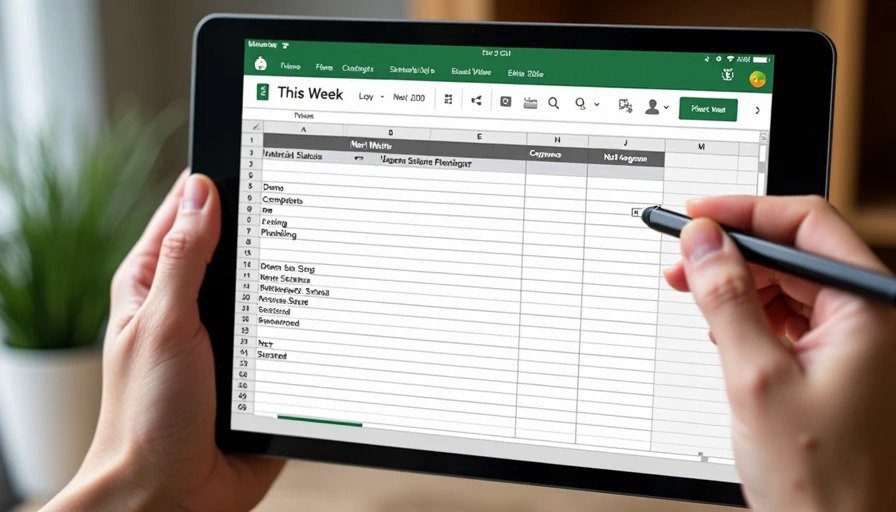
That was the key. I didn't ask him to invent a new system. I didn't ask him to spend hours writing a detailed report. I gave him a pre-made, dead-simple Google Sheets template that he could fill out in ten minutes on his phone.
I also made it clear that this wasn't about control. It was about coordination. If I knew what was coming, I could order materials on time, clear the site, and stay out of his way.
The actual Google Sheets template
Here's what I created. It's simple, not fancy, but it works. I'm sharing it here so you can copy it.
Tab 1: Week of [Date] – What Happened This Week
Trade / Task | Status | Notes |
|---|---|---|
Demo | Complete | |
Framing | Complete | |
Plumbing rough-in | In progress | Plumber will finish Monday |
Electrical rough-in | Not started | Electrician scheduled Tuesday |
HVAC rough-in | Complete | |
Insulation | Not started | |
Drywall | Not started |
Tab 2: Week of [Date] – What's Planned Next Week
Day | Morning | Afternoon | Notes |
|---|---|---|---|
Monday | Plumber finishes rough-in | Inspector | Need me on site at 10am for inspection |
Tuesday | Electrician rough-in | Electrician rough-in | |
Wednesday | Insulation | Insulation | |
Thursday | Drywall delivery | Drywall delivery | Need to clear driveway |
Friday | Drywall hang | Drywall hang |
Tab 3: Materials Status
Item | Ordered? | Delivered? | On-site? | Notes |
|---|---|---|---|---|
Tub | Yes | Yes | Yes | |
Tile | Yes | No | No | Expected Friday |
Vanity | Yes | Yes | Yes | Damaged? Need to inspect |
Light fixtures | Yes | No | No | Expected next week |
Windows | Yes | Yes | Yes | |
Countertop | No | N/A | N/A | Need to order this week |
Tab 4: Issues / Decisions Needed
Issue | Who's responsible | Decision needed by | Status |
|---|---|---|---|
Vanity damaged | Supplier | This week | Waiting on replacement |
Shower niche size | Homeowner | Wednesday | I need to confirm |
Paint colours | Homeowner | Friday | I'll send samples |
That's it. Four tabs. Ten minutes to fill out. And it changed everything.
How it actually worked in practice
The first week, my GC sent me a mostly blank sheet with a few notes. The second week, it had more detail. The third week, he was actually using it to remind himself of what he needed to do. It became his tool as much as mine.
The benefits were immediate:
No more surprise trade visits. I knew on Friday that the electrician was coming on Tuesday, so I could be there to answer questions.
No more missing materials. I could see on the materials tab that the tile hadn't arrived, so I could chase the supplier before it became a crisis.
No more "I thought you knew." When something went wrong – and things did go wrong – we had a written record of who was supposed to do what by when.
No more Friday panic. I stopped texting my GC every day. I saved my questions for the Friday update. He was less stressed. I was less stressed.
The biggest win came in week 6, when the tile supplier delayed a shipment by a week. Because I had the schedule, I saw it coming. I asked my GC to rearrange the work so the tile setter could do something else while we waited. We didn't lose a single day. Before the schedule, that would have been a full week of idle time.
What I learned about getting a contractor to communicate better
Here are the hard-won lessons from this experiment:
1. Make it about them, not about you.
Don't say "I need more communication." Say "I want to make your life easier." Contractors are busy. They're not ignoring you out of malice – they're just juggling fifteen jobs. If you make the request sound like it's for their benefit, they're more likely to agree.
2. Do the work for them.
I spent an hour building that template. It saved me dozens of hours of anxiety and follow-up. Don't ask your GC to invent a new system. Give them a system that's already set up. Google Sheets is free, accessible on any phone, and doesn't require any training.
3. Be consistent, but not pushy.
I didn't demand the update every Friday at 5 p.m. on the dot. If it came on Saturday morning, fine. If it was brief, fine. The goal was not perfection. The goal was a habit. A brief, imperfect update is infinitely better than no update at all.
4. Use it as a two-way tool.
I didn't just read the schedule – I added to it. If I ordered something, I updated the materials tab. If I had a question, I put it in the issues tab. It became a shared document, not a one-way report.
5. Celebrate the wins.
When the schedule helped us avoid a crisis, I made sure to thank my GC. "That weekly update saved us this week – I really appreciate it." Positive reinforcement works on contractors just like it works on everyone else.
What about the people who say "this won't work with my GC"?
I know some of you are reading this and thinking, "My GC would never fill out a spreadsheet. He barely responds to texts."
I hear you. This approach assumes a baseline of professionalism. If your GC is actively hostile to basic communication, a template isn't going to fix that. But I'd argue that if your GC won't even spend ten minutes a week on a simple status update, that's a red flag about the whole project. It's not about the template. It's about whether they see you as a partner or an obstacle.
If you're worried about resistance, you can start smaller. Try a shared Google Doc with just two sections: "This week" and "Next week." No materials tab, no issues tab. Just the basics. Once that habit is formed, you can add more.
The bottom line
Getting a contractor to communicate better isn't about demanding more. It's about making communication effortless. A Google Sheets template with four tabs takes ten minutes a week. That ten minutes saved me weeks of delays, thousands of dollars, and more stress than I care to remember.
If you're a homeowner struggling with communication, I genuinely encourage you to try this approach. Start with a conversation that makes it about their convenience, not your neediness. Give them a tool that's already built. And be patient – habits take time to form.
Now it's your turn.
I've shared my template, my story, and my lessons. But I know I'm not the only one who's figured out a way to improve communication with a contractor.
What did YOU do that made your contractor communicate better? Did you use a different system? A project management app? A weekly phone call? A whiteboard on the job site?
What was the hardest part of getting the communication to improve? Did you face resistance? Did it take multiple conversations?
What was the payoff? Did better communication save you time, money, or just your sanity?