

Let me tell you about my neighbour Dave.
Dave is a smart guy. He runs a small tech consultancy, he's handy enough to hang a picture level, and he did his homework before his kitchen renovation. He interviewed three GCs, got detailed quotes, picked the one with the best references, and felt ready for anything.
The day demolition started, Dave's crew tore out the old kitchen cabinets, ripped up the flooring, and then—because Dave had decided to replace the two old windows in the kitchen—they knocked out the existing window frames too. Great progress. Day one, done.
On day two, the GC called Dave. "Hey, we need the new windows here by next week so we can frame the openings and get the trim carpenters in. Where are they?"
Dave blinked. "I ordered them yesterday."
Silence on the phone. Then: "Yesterday? You didn't order them two months ago?"
And that's when Dave learned the 8-week rule.
The Lead-Time Trap That Nobody Warns You About
Here's the thing about windows: unless you're building a spec home with standard sizes from a big-box store, your windows are almost certainly custom. Even if you think you have standard openings—say, 36 inches by 48 inches—there's a good chance the actual rough opening is 35 ¾ by 47 ½, or the existing frame is out of square, or you want a specific grid pattern, or a specific colour on the exterior, or a specific glass coating for energy efficiency.
Every one of those choices turns a "stock" item into a "made-to-order" item. And made-to-order windows take time.
Typical lead times for custom windows in North America:
Vinyl windows, basic: 4–6 weeks
Fibreglass or composite: 6–8 weeks
Wood or wood-clad: 8–12 weeks
European-style tilt-and-turn: 10–14 weeks
But here's the kicker: those lead times are quoted from the date the factory receives the order. Not from the date you started thinking about windows. Not from the date you measured. Not from the date you signed the contract. The clock starts ticking only when the order is submitted and the deposit is paid.
If you order windows the day demolition starts, you're looking at week 2 or 3 of your project before the factory even begins making them. By the time they arrive, your GC has already moved on to another job, your trim carpenters are booked elsewhere, and your kitchen is sitting there with gaping holes, waiting.
Why Trim Carpenters Wait — And Why That Wait Is Expensive

Let's talk about what happens when windows aren't on site when they're supposed to be.
The renovation schedule usually goes like this:
Demo
Rough framing, structural work (including new window openings)
Rough electrical, plumbing, HVAC
Insulation
Drywall
Trim carpentry — window casings, baseboards, crown moulding, door jambs
Flooring
Cabinets
Paint
Finishes
Trim carpentry sits right after drywall. But trim carpenters can't finish around windows unless the windows are physically installed and the openings are properly flashed, sealed, and secured. They need the actual window unit in place so they can measure and cut the casing perfectly flush. Without the window, they can't do their job.
So the window arrives late. The trim carpenters show up on schedule, look at the empty holes, shrug, and leave. They don't wait around for two weeks—they have other jobs, other clients. Your GC now has to rebook them. Good trim carpenters are booked 4–6 weeks in advance, because they're in high demand. So your window delay doesn't just push trim work back by two weeks—it pushes it back by six to eight weeks, because that's the next opening on their calendar.
And during those six to eight weeks, your project is stalled. No one can move forward. The floor can't go in until the trim is done (because trim goes over the flooring). The painters can't paint until the trim is installed and caulked. The kitchen installers can't set cabinets until the floors are done. It's a domino effect.
Let's put a number on that delay:
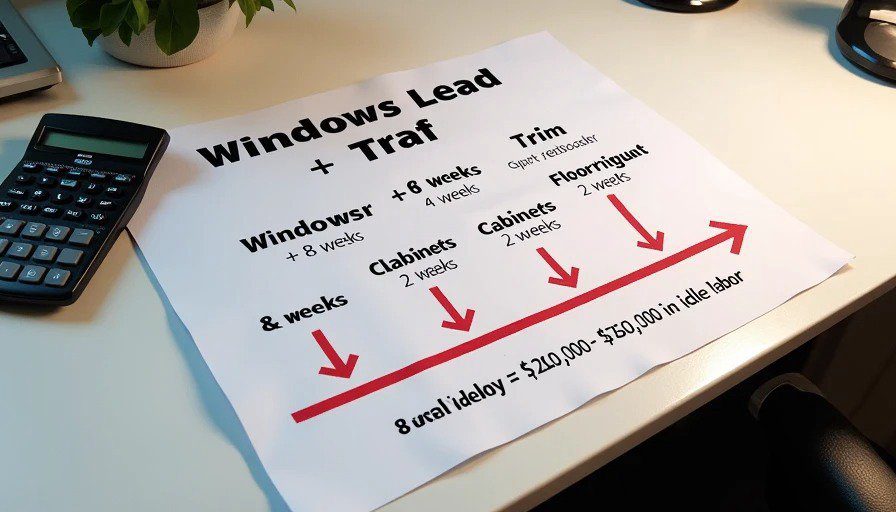
Windows ordered on demolition day: +8 weeks to manufacture, +2 weeks shipping. Arrive week 10.
Original trim schedule: week 5 or 6.
New trim schedule (after rebooking): week 14.
Total project delay: 8 weeks.
Now, what does 8 weeks cost?
If you're paying a GC with a team of 2–3 workers onsite, idle labour costs $500–$800 per day. Eight weeks of idle time = $20,000–$32,000 in wasted labour.
If you're paying your mortgage/rent on a house that's unlivable during renovation, that's another $2,000–$5,000 per month.
If you're eating takeout every night because your kitchen is unusable, that's $200–$400 per week.
If you're paying storage for furniture or appliances that can't be moved in, add more.
And the hardest cost: the cost of your patience, your relationship, your mental health. Living in a construction zone for two extra months is not nothing.
The 8-Week Rule: A Simple Prescription
Here's the rule that every experienced renovator eventually learns:
Order your windows at least 8 weeks before the first day of demolition. Ideally, order them the day you sign your contract—or even earlier.
Why so early? Because:
You don't need the exact final dimensions until the old windows are out, but you can measure the rough openings from the inside, or better yet, have a window supplier come out and measure for you. Many suppliers will do a free site measure and give you a firm quote. Use that.
Once you have a quote, you can place the order. The supplier will hold the order and time the manufacturing to coincide with your project start, but the lead time is already baked in.
Even if your GC finds something unexpected during demo—like rotted framing, non-standard rough openings, or a structural header that needs to be adjusted—you can usually accommodate those changes in the window trim, because the window size itself is still correct for the opening.
In other words: order the size now, and adjust the surrounds later. That's much cheaper than waiting to order the size and losing months.
What about warranty? Some people worry that ordering windows too early means they'll start their warranty period before installation. That's fair, but many high-quality window brands tie the warranty to the installation date, not the purchase date. Check with your supplier—most are accommodating if you explain the construction schedule.
What about storage? Windows take up space. They need to be kept dry, upright, and protected from the elements. But compared to the cost of an 8-week delay, a $200 storage locker or a corner of your garage is a bargain.
Dave's Story (Continued)
Back to my neighbour. Dave eventually got his windows—at week 12 of his renovation, instead of week 4. His GC had to rebook the trim crew, which pushed the floors, which pushed the cabinets, which pushed the countertops, which pushed the final inspection. His kitchen was supposed to be done in 10 weeks; it took 18. He spent an extra 8 weeks eating microwave meals in his dining room, trying not to trip over boxes of tile that had been sitting in the hallway since week 2.
He told me, "I would have paid any amount of money to go back and order those windows the day I signed the contract. It would have cost me nothing extra—just a phone call. And it would have saved me two months of misery."
Dave is not alone. I've heard versions of this story from dozens of homeowners. The windows always sneak up on you, because they're not as exciting as the kitchen cabinets, or the backsplash tile, or the new island. They're just... windows. Functional, unglamorous, and absolutely critical to the sequence of work.
What You Can Do Right Now
If you're reading this and you haven't signed a contract yet—or you have and you're still in the planning phase—here's your action plan:
Measure your windows today. Get a tape measure and write down the rough opening width, height, and depth for every window you plan to replace. Or call a window supplier and schedule a measure. This takes 30 minutes.
Get a quote. Most suppliers will quote within a day or two. Ask them for the lead time in writing.
Place the order as soon as you have your architectural plans finalized, even if demolition is two or three months away. The supplier will manage the production queue—they'll start manufacturing close to your requested delivery date.
Confirm with your GC that he's okay with you ordering early. He should be thrilled—it means one less thing to worry about.
Store the windows safely when they arrive: upright, off the ground, protected from rain and direct sun. Don't stack heavy objects on top.
And if you're already past demo, and you haven't ordered? Call your supplier right now. Pay the express fee if you have to. It's cheaper than idle labour.
Did Your Window Order Sneak Up on You? How Did You Handle It?
We've all been there—or we know someone who has. The windows are the classic renovation blind spot. They're not the sexiest part of the project, but they'll make or break your timeline.
So I'm asking the community:
Did you order your windows on time, or did you fall into the 8-week trap?
If you delayed, what happened? Did you have to rebook trades? Did you eat the cost? Did you find a clever workaround?
If you ordered early, how did you feel when they arrived? Did you have a storage plan?
What's the most creative solution you've seen to the window lead-time problem? A friend of mine used tempered glass panels from a glazier as a temporary fill-in while waiting for custom windows—not perfect, but it kept the weather out.
I'll start: my personal mistake was ordering the kitchen windows at the same time as the rest of the house, but I didn't check that one of them was a special size for a vent hood exhaust. That added an extra 3 weeks. In hindsight, I should have double-checked every opening with the GC before submitting the final order.