
Metric screw sizes become a scheduling problem the moment a replacement hinge, cabinet fitting, appliance bracket, or plumbing cover arrives without usable fasteners. The label might say M4 x 20, while the hardware drawer contains something that looks close enough. That is where a ten-minute installation becomes a three-day delay. Understanding metric screw sizes lets you identify what is already on site, order the correct replacement, and stop a trade from improvising with damaged threads.
Read the marking before opening the package
A typical metric designation looks like M5 x 0.8 x 30. The M means the screw uses a metric thread. The 5 is the nominal outside diameter in millimeters. The 0.8 is the thread pitch, meaning the distance from one thread crest to the next. The 30 is the screw length, usually measured from directly beneath the head to the tip for pan-head, button-head, and hex-head screws.
Metric screw sizes are not interchangeable simply because two screws have the same diameter. An M6 x 1.0 and an M6 x 0.75 both measure about 6 millimeters across, but their threads advance at different rates. One can enter a hole for several turns and then bind, cross-thread, or break the captive nut. Record diameter, pitch, length, head style, drive type, and material before ordering. A photo beside a ruler is useful, but it is not a substitute for measuring pitch.
For a renovation schedule, put the fastener specification beside the item it belongs to. Write “bathroom exhaust grille: M4 x 12 stainless pan head” rather than “small screws.” That wording gives a supplier, electrician, or hardware counter enough information to help without another site visit.
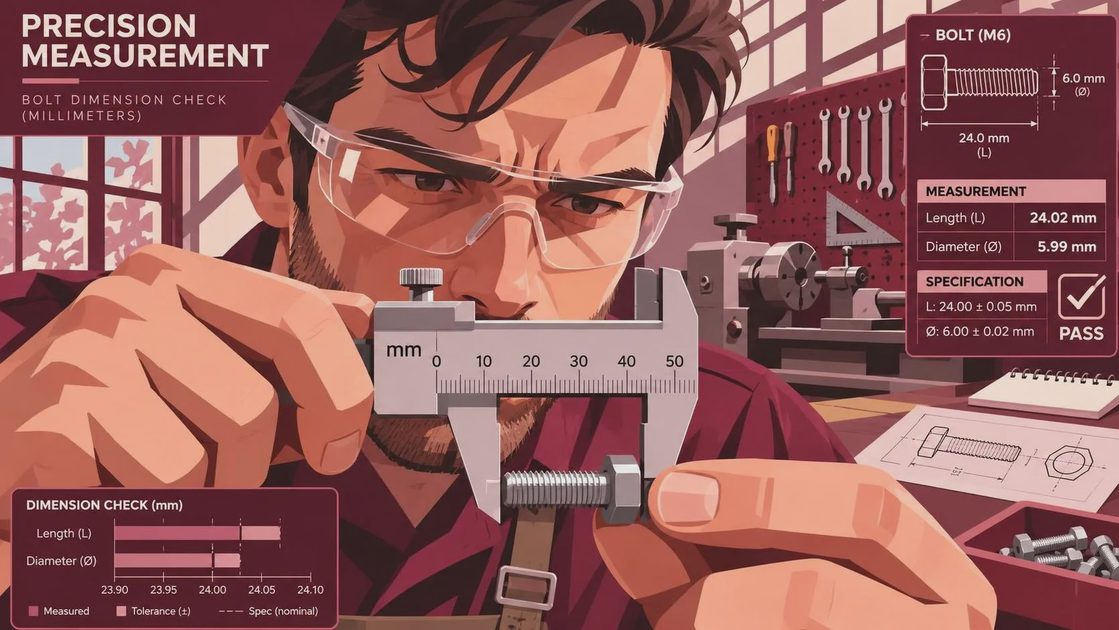
Diameter and pitch: the two measurements that stop rework
Diameter is normally identified with a caliper, but a thread gauge is faster for pitch. Common coarse metric screw sizes include M3, M4, M5, M6, M8, and M10. Typical coarse pitches are 0.5 millimeters for M3, 0.7 for M4, 0.8 for M5, 1.0 for M6, 1.25 for M8, and 1.5 for M10. These are useful starting points, not permission to guess. Fine-thread versions exist, especially in machinery, automotive parts, and adjustable hardware.
If you do not have a pitch gauge, compare the unknown screw against a known fastener or use a thread identification chart at the hardware store. Lay both threads together and check whether the ridges stay aligned along the full length. Do not force a screw into an expensive fitting to test it. A damaged aluminum insert can turn a small fastener purchase into a $40 to $150 repair, plus the trade time to remove and replace the fitting.
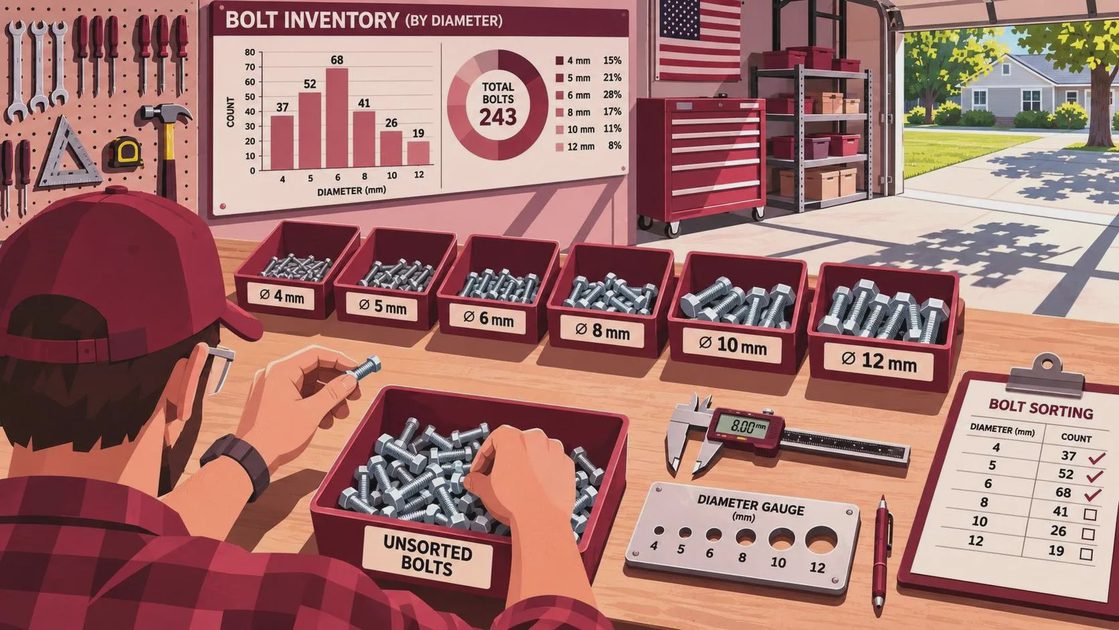
The pilot hole creates another coordination issue. A machine screw usually enters a tapped hole or a nut, while a metric wood screw cuts its own path into timber or composite material. A designation such as 5 x 50 on a wood screw does not describe pitch in the same way as M5 x 50. Keep machine screws and wood screws in separate labeled bins.
Length, head, and drive are project-critical
Length should be selected from the joint, not from the old screw alone. If a cabinet hinge is being moved from a 16-millimeter panel to an 18-millimeter panel, the original length may no longer provide the same engagement. Too short and the fitting pulls loose. Too long and the tip can emerge through a finished face, strike wiring, or interfere with a drawer.
Head shape also determines whether the screw seats correctly. A countersunk screw is designed to finish flush in a matching countersunk hole. A pan head remains above the surface and spreads load over a wider area. A socket-head cap screw needs clearance for an Allen key, while a hex-head screw needs a wrench or socket. Drive type matters during installation: Phillips, Pozidriv, Torx, and hex drives are not interchangeable just because the bit appears to fit.
Before the drywall crew closes a wall, verify that brackets, access panels, and service covers have the correct fasteners. This is particularly important in kitchens and utility rooms, where appliance installers may need to remove the same panel later. A $6 box of replacement screws is cheaper than reopening finished work.
Material and finish should match the location
For dry interior work, zinc-plated steel is often adequate. Stainless steel is the safer choice for bathrooms, exterior trim, kitchens near sinks, and locations exposed to cleaning chemicals. A2 stainless is common for general corrosion resistance; A4 is selected for more demanding moisture or coastal conditions. The screw material still needs to match the strength requirement. Stainless fasteners resist corrosion well but can gall when driven aggressively, especially in stainless threads.
Avoid mixing dissimilar metals without checking the application. An exterior aluminum component paired with an unsuitable steel screw can develop corrosion around the joint. In Portland, persistent moisture makes finish and drainage part of the fastener decision. In Phoenix, heat and ultraviolet exposure affect surrounding plastics and sealants more than corrosion, but exterior screws still need a weather-appropriate finish. Put the location and exposure on the purchase note.
Build a fastener check into the schedule
Set the verification date before the installation date, not after a missing screw stops the trade. For each fitting, photograph the installed part, remove one sample if permitted, measure it, and label the sample in a small bag. Confirm the exact thread with a nut or gauge, then order a few extras. For common sizes, ordering a box of 25 or 100 often costs only a few dollars more than a tiny packet and protects the schedule against dropped or damaged hardware.
Create one procurement line per specification. “M6 x 1.0 x 25, zinc-plated, socket head, 20 pieces” is actionable. “Bolts for railing” is not. Record the supplier, order date, promised arrival, and person responsible for checking the delivery. When the box arrives, test one screw before distributing the hardware to the plumber, electrician, or cabinet installer.
The site post-mortem: what usually goes wrong
The most common failure is assuming every metric screw sizes chart applies to every product. Charts help identify standard dimensions, but manufacturers can use unusual pitches, proprietary shoulder lengths, or captive washers. The second failure is ordering by diameter and length while ignoring the head. A countersunk screw cannot replace a pan head in a bracket designed for a flat seating surface.
Another recurring mistake is treating a partially threaded screw like a fully threaded machine screw. A smooth shoulder changes how clamping force develops and can be essential in hinges or brackets. Finally, people often discover the shortage on installation morning. If the part is imported, allow five to ten business days for a specialist replacement rather than assuming a local store will stock it.
The practical rule is simple: identify the thread, verify the seating surface, confirm the material, and stage the fastener before the trade arrives. Metric screw sizes are a small line item, but they can control whether a finishing task takes twenty minutes or waits until the next procurement run. If it is not on the schedule, it is not happening. What fastener specification has caused the most avoidable delay on your renovation?